
Anthropic’s Claude ecosystem is moving quickly from “chat with an AI” toward building serious software systems around Claude.
And its Claude Certified Architect – Foundations certification, or CCAR-F, reflects that.
This isn’t an exam built primarily around memorizing terminology. It focuses heavily on the architectural decisions involved in building real applications with Claude: agents, tools, Claude Code, the Claude API, the Agent SDK, Model Context Protocol, prompt engineering, structured output, context management, reliability, and more.
That’s why we’ve created our newest course:
Ultimate Claude Certified Architect – Foundations
For our launch, you can enroll for just $9.99 for the next 5 days:
Important: Who can take the CCAR-F exam?
Before we go any further, there’s an important limitation you need to know about.
The Claude Certified Architect – Foundations certification exam is currently only available to people at Anthropic partner organizations.
If you aren’t working with an eligible Anthropic partner, you currently won’t be able to sit for the certification exam.
We want to make that very clear. Don’t buy an exam prep course because you think the CCAR-F certification is generally available when it isn’t.
That said, the material covered by the certification is also a very good roadmap for learning the skills required to build production systems with Claude, so the course may still be useful even if certification isn’t your immediate goal.
Passing CCAR-F is only half the objective
Certification courses can easily turn into long lists of facts to memorize.
We didn’t want to build that course.
The CCAR-F exam itself emphasizes practical judgment about architecture, configuration, and engineering trade-offs. The official exam structure reflected in our course consists of five domains covering Agentic Architecture, Tool Design and MCP, Claude Code, Prompt Engineering, and Context and Reliability.
So our goal is twofold:
First, prepare you to pass the CCAR-F certification exam.
Second, make you better at using Claude as an AI engineer.
Those two objectives reinforce each other.
If you genuinely understand why one agent architecture works better than another, how Claude chooses tools, when to use MCP, how to control Claude Code, how to manage context, and how to build reliable structured outputs, the certification questions become much easier to reason through.
A hands-on Claude engineering course
The course contains roughly 79 lessons across seven sections, with quizzes, labs, and exam preparation woven throughout.
But the most important part isn’t the lesson count.
It’s what you’ll actually do.
The course includes six hands-on labs designed around realistic engineering scenarios.
You’ll build an MCP server and learn how tool descriptions influence Claude’s behavior. You’ll construct multi-agent systems using the Claude Agent SDK. You’ll work with hooks and deterministic controls. You’ll integrate Claude Code with a development workflow. You’ll build structured extraction pipelines with validation and retry logic. And you’ll learn how to manage long-running Claude Code sessions and context effectively.
For example, the MCP lab has you build three tools, deliberately create a tool-routing failure, and then diagnose and correct it.
Another lab builds a coordinator with search, analysis, and synthesis subagents, including parallel execution and preservation of citations across agents.
These aren’t demonstrations you’re expected to watch passively. They’re designed to make the concepts stick.
Learn Claude Code, MCP, agents, prompting, reliability, and more
Among the topics covered are:
Claude API fundamentals
You’ll understand the request and response structure underneath Claude applications, including messages, content blocks, generation controls, tool use, and the agentic loop.
Tool use and Model Context Protocol
Learn how Claude selects and calls tools, how to design tools that are selected reliably, and how MCP provides a standard architecture for connecting Claude to external capabilities.
Agentic architecture
Build agent loops, coordinator/subagent architectures, parallel agents, deterministic hooks, human handoffs, sessions, and adaptive workflows.
Claude Code
Learn how CLAUDE.md, skills, commands, permissions, plan mode, hooks, headless execution, and CI workflows fit together.
Prompt engineering and structured output
Move beyond vague prompting toward explicit criteria, reliable schemas, validation, retries, confidence scoring, and scalable review architectures.
Context and reliability
Treat the context window as an engineering constraint, handle compaction and long sessions, propagate failures properly, preserve provenance, and decide when a human needs to get involved.
The final portion of the course concentrates on exam readiness, including scenario analysis, understanding how exam questions are constructed, recognizing distractors, and reviewing the concepts behind each exam domain.
Quizzes and full-length CCAR-F practice exams
Every major section includes exam-style quiz questions designed to reinforce the concepts you’ve just learned.
You’ll also get two realistic full-length CCAR-F practice exams, built to help you find weak areas before the real certification exam.
Each practice exam includes detailed answer explanations.
That’s important to us.
A practice exam shouldn’t just tell you that you got a question wrong. It should help you understand why the right answer is right, why the distractors are wrong, and what principle you should remember when you encounter a similar situation again.
In other words, the practice tests aren’t just assessments. They’re part of the course.
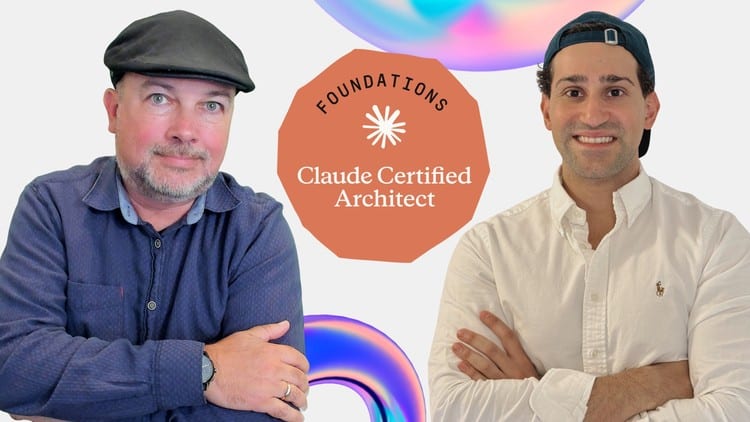
Meet your instructors
Puria Izady
Puria Izady is the lead instructor for Ultimate Claude Certified Architect – Foundations.
Puria is a Solutions Architect at AWS specializing in Generative AI and Machine Learning, and is the creator behind Pumping Code.
He brings the hands-on engineering perspective that a course like this needs, particularly when the certification itself is so heavily focused on practical architecture and implementation.
Frank Kane
I’m Frank Kane, and I’ve taught AI and machine learning to more than 1.2 million people around the world.
I hold 26 patents in machine learning and spent 9 years at Amazon as a senior engineer and senior manager.
I’ve spent many years developing technical certification courses and practice exams, and my role here is to help turn all of this material into something you can learn efficiently and apply both on the exam and afterward.
Launch special: $9.99 for 5 days
Because this course is brand new, we’re launching it with a special introductory price.
For the next 5 days, you can enroll in Ultimate Claude Certified Architect – Foundations (CCAR-F) for $9.99:
If you’re preparing for the Anthropic Claude Certified Architect – Foundations certification, we hope the course helps you walk into the exam with confidence.
But we also hope it does something more lasting.
We want you to finish the course understanding how to design better agents, build better Claude integrations, use Claude Code more effectively, and make better architectural decisions when putting AI systems into production.
And if you do take the course, please leave us an honest review after you’ve had a chance to work through it. Reviews and feedback are especially important when a course is brand new, and they help us figure out what we should improve next.
Thank you for having us along on your learning journey!
Frank Kane & Puria Izady
